The Eucharist is "the source and summit of the Christian life."
~Catechism of the Catholic Church 1265.
“Since Christ Himself has said, ‘This is My Body,’ who shall dare to doubt that it is His Body?”
~St Peter in Acts 2:38
And he took bread, and when he had given thanks he broke it and gave it to them, saying, “This is my body which is given for you. Do this in remembrance of me.”
~Jesus
“What you see is the bread and the chalice; that is what your own eyes report to you. But what your faith obliges you to accept is that the bread is the body of Christ, and the chalice is the blood of Christ. This has been said very briefly, which may perhaps be sufficient for faith; yet faith does not desire instruction.”
~St. Augustine
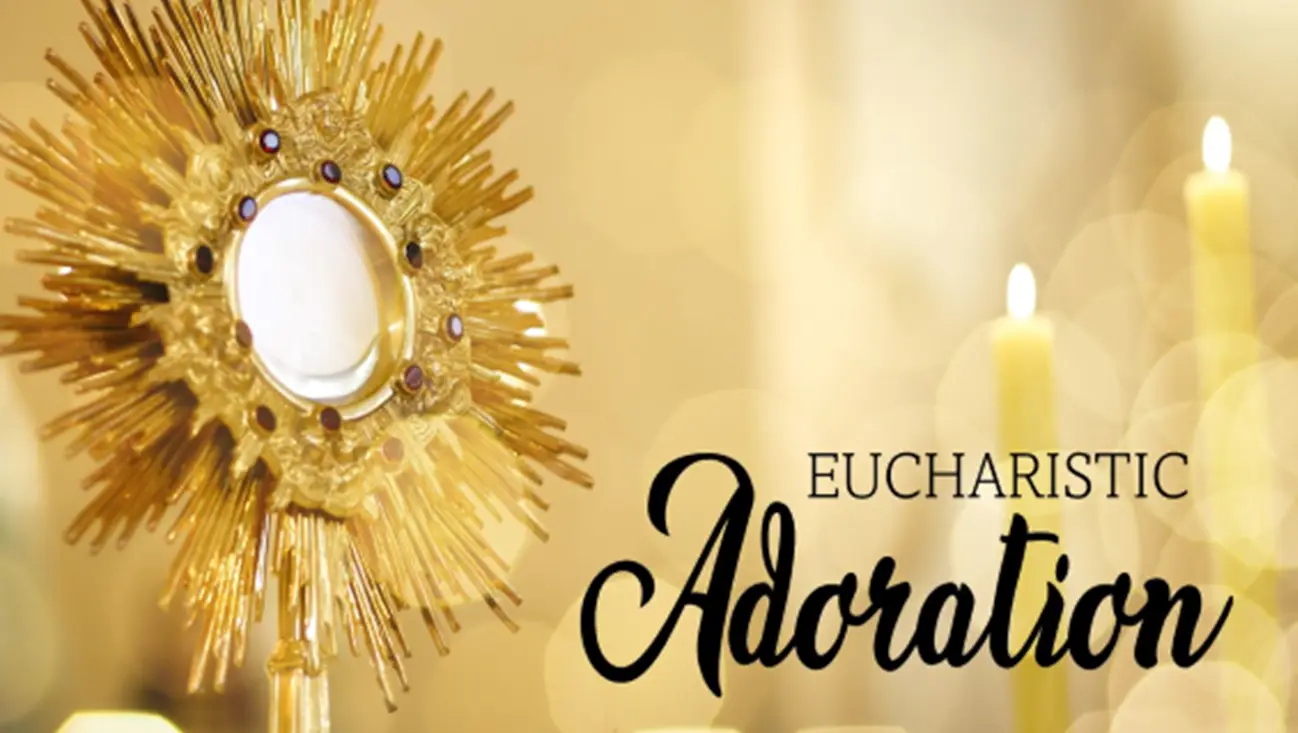
The Eucharist is the source and summit of the Christian life. The term “Eucharist” originates from the Greek word eucharistia, meaning thanksgiving.
In the celebration of the Eucharist, bread and wine become the Body and Blood of Jesus Christ through the power of the Holy Spirit and the instrumentality of the priest. The whole Christ is truly present — body, blood, soul, and divinity — under the appearances of bread and wine, the glorified Christ who rose from the dead. This is what the Church means when she speaks of the “Real Presence” of Christ in the Eucharist. (Excerpt from USCCB website)
The transformed bread and wine are truly the Body and Blood of Christ and are not merely symbols. When Christ said “This is my body” and “This is my blood,” the bread and wine are transubstantiated. Though the bread and wine appear the same to our human faculties, they are actually the real body and blood of Jesus. (Excerpt from USCCB website)
The Lord Jesus, on the night before he suffered on the cross, shared one last meal with his disciples. During this meal our Savior instituted the sacrament of his Body and Blood. He did this in order to perpetuate the sacrifice of the Cross throughout the ages and to entrust to the Church a memorial of his death and resurrection. The Institution of the Eucharist is written down in the four Gospels below (Excerpt from USCCB website):
Jesus gives himself to us in the Eucharist as spiritual nourishment because he loves us. By eating the Body and drinking the Blood of Christ in the Eucharist, we become united to the person of Christ through his humanity. “Whoever eats my flesh and drinks my blood remains in me and I in him” (Jn 6:56). In being united to the humanity of Christ, we are at the same time united to his divinity. Our mortal and corruptible natures are transformed by being joined to the source of life. (Excerpt from USCCB website)
The Liturgy of the Eucharist begins with the preparation of the gifts and the altar. As the ministers prepare the altar, representatives of the people bring forward the bread and wine that will become the Body and Blood of Christ. The celebrant blesses and praises God for these gifts and places them on the altar, the place of the Eucharistic sacrifice. In addition to the bread and wine, monetary gifts for the support of the Church and the care of the poor may be brought forward. The Prayer over the Offerings concludes this preparation and disposes all for the Eucharistic Prayer.
(Excerpt from USCCB website)
The Eucharistic Prayer is the heart of the Liturgy of the Eucharist. In this prayer, the celebrant acts in the person of Christ as head of his body, the Church. He gathers not only the bread and the wine, but the substance of our lives and joins them to Christ’s perfect sacrifice, offering them to the Father.
The introductory dialogue establishes that this prayer is the prayer of the baptized and ordained, is offered in the presence of God, and has thanksgiving as its central focus. Following this dialogue, the celebrant begins the Preface, which consists of four different Eucharistic Prayers. After these prayers, communion is then given.
The following timeline follows the traditional Liturgy of the Eucharist:
- Presentation of the Gifts and Preparation of the Altar
- Prayer over the Offering
- Eucharistic Prayer
- Preface
- Holy, Holy, Holy
- First half of prayer, including Consecration
- Mystery of Faith
- Second half of prayer, ending with Doxology
- The Lord’s Prayer
- Sign of Peace
- Lamb of God
- Communion
- Prayer after Communion
(Excerpt from USCCB website)
“Jesus awaits us in this sacrament of love.”
~St. John Paul II, Dominicae cenae, no. 3
The presence of Christ in the Eucharist is real, true, and substantial.
USCCB
“It is called: Eucharist, because it is an action of thanksgiving to God.”
~Catechism of the Catholic Church 1328
Eucharist “makes present the one sacrifice of Christ the Savior.”
~Catechism of the Catholic Church 1330
Eucharistic Resources
Let us strive to renew the Church by enkindling a living relationship with Our Lord Jesus Christ in the Holy Eucharist.
The Mystery of the Eucharist in the Life of the Church
Free Online Faith Formation
Interested in expanding your faith? Franciscan at Home offers a wide range of online workshops to study your faith. The style of learning for Franciscan at Home classes allows individuals to complete the workshop at his/her own pace. Most workshops are setup in a video with reflection style and are typically 8 short videos per class. Access to Franciscan at Home has been provided by the Knights of Columbus free of charge.
Eucharistic Renewal (ER) Track
But only say the word and my soul shall be healed…
Called to Him. Kept in Him. Made new in Him. God’s generosity and His Fatherly love is most fully manifest in His Son’s incarnation in ancient Israel and His continuing presence in the Blessed Sacrament upon every altar. Our lives flow from the Eucharist and lead back to the Eucharist, so that we may be filled with God’s life, sent into the world to proclaim the Good News, and be strengthened and invigorated for a life lived for others. This pragmatic and deeply inspiring set of workshops addresses three critical aspects of the Eucharistic renewal so needed today:
- How to see God’s gift of the Eucharist, rooted in knowing Jesus personally and loving the sacred liturgy.
- How to be formed for a Eucharistic life of intimate devotion and radical trust.
- How to give the saving truths of the Eucharist to others effectively in the home, the classroom, and in any relationship.
It is our privilege to pass on this magnificent inheritance of faith to the next generation, echoing the action of faithful disciples from the centuries before us. This track is designed to help you, whether you are a priest, parent, parish catechetical leader, catechist, teacher, youth minister, or parishioner, to better understand the Eucharist and its matchless importance in God’s plan for humanity.
Ministry of Parenting (MP) Track
The Catechetical Institute views parenting as the critical catechetical role in the Church. Our desire is to help families in our challenging modern culture see God’s plan for the domestic church and the school of holiness it creates as the decisive element in bringing about a culture of life. The workshops in this track are not intended to result in any certification but instead aim at a far more fundamental end: forming adults who know how to live a missionary life in marriage and judge nothing in life as great as the work of parenting toward sainthood and striving for spousal sanctity. To foster this, a great variety of pragmatic and imaginative workshops are offered by the Catechetical Institute as electives in every track and collected together in this track.
Forming Faith at Home (FFH) Track
In this time of unprecedented challenge, this brief and very doable set of workshops can help parents who won’t be able to send their children back to parish-based or school programs in the normal way. It is intended to help parents attune to a more home-focused formation during the coming months at least, if not longer. There is also a couple of workshops for parish leaders trying to find creative ways to help families during this time.